
REVIEW · MARRAKECH
Marrakech Jewish Heritage and souks Tour
A walk through the Mellah teaches by sight. This Marrakech tour links the Jewish Quarter to everyday life you can still see today, from synagogues and cemeteries to the markets that shaped trade and daily routines.
I love how the route mixes specific sites with practical context, so you are not just looking at old buildings. You also get time in the souks after the heritage stops, which is when the story turns into real Marrakech, spice stalls, craft workshops, and street life.
One thing to plan for: not every stop comes with admission included. The synagogue and cemetery have separate admission rules, and access can sometimes depend on local practices, so I recommend confirming what will be open on your day.
In This Review
- Key highlights to know before you go
- Marrakech’s Mellah: a Jewish-quarter walk with souk payoff
- Why this tour works: real places plus flexible pacing
- Stop 1, the Mellah lanes: synagogues nearby, trade in the air
- Slat Al Azama Synagogue: architecture, women’s gallery, and what to expect
- Miaara Jewish Cemetery: quiet ground, and possible access rules
- Jemaa el-Fnaa and Souk Semmarine: trading stories for shopping reality
- Guides make it: Chachi, Noura, Ismail, and Saïd
- Price and value: what $95 buys for a half-day
- Timing, weather, and how to plan the rest of your day
- Who should book this Marrakech Jewish heritage and souks tour?
- Should you book this tour?
- FAQ
- How long is the Marrakech Jewish Heritage and souks Tour?
- What is the price per person?
- Is this tour private or group-based?
- What are the main stops on the tour?
- What is included in the price?
- What is not included?
- Where does the tour start and end?
- Does the tour require good weather?
Key highlights to know before you go
- Mellah walking route: Small lanes where you can connect Jewish life to Marrakech’s street layout
- Slat Al Azama Synagogue visit: Architecture details, plus admission that is not included
- Miaara Jewish Cemetery stop: More than a quick look, with access conditions to keep in mind
- Souk Semmarine time: A long block for handicrafts and good shopping hunting
- Private flexibility: You can shape the tour to your group’s interests
- Strong guide impact: Names that come up often include Chachi, Noura, Ismail, and Saïd
Marrakech’s Mellah: a Jewish-quarter walk with souk payoff
Marrakech can feel like a nonstop show, but this tour slows you down in the right place. You start in the Mellah area, where the streets, courtyards, and walls tell you something before your guide even talks. That matters because Jewish life in Morocco was never just a museum topic, it was tied to neighborhoods, trades, and community institutions.
What makes this especially worthwhile is the way you get both sides of the equation. You see the Jewish Quarter, then you move into the souks where the city’s crafts and commerce still run on the same energy. This is the kind of tour where your brain goes from what something used to be, to how people lived and worked right there.
Other medina and souk walks around Marrakech
- Shopping in the Souks of Marrakech Private Tour
★ 5.0 · 620 reviews - Souks Shopping Tours
★ 5.0 · 395 reviews - Private Tour: Marrakech Medina By Night
★ 5.0 · 389 reviews - Marrakech Shopping Tours : Private Souks Tour
★ 5.0 · 345 reviews
Why this tour works: real places plus flexible pacing
I like tours that give structure without feeling robotic. This one does that. You have a half-day plan with clear stops, and you still have room to steer based on what your group actually wants to know. If your focus is architecture, you can ask about courtyards and layouts. If your focus is markets, you can spend more time with the guide near the places that connect to herbs, spices, and trading.
Another reason it works well is the timing. Around four hours is long enough to get meaning out of the Jewish Quarter, but short enough that you are not stuck in a single neighborhood all day. When the walking ends, you are free to eat, browse, and explore at your own pace.
And yes, you will be on foot. You should show up with comfortable shoes and a water bottle. The city is active, and these lanes can be busy, even when you are in a quieter setting.
Stop 1, the Mellah lanes: synagogues nearby, trade in the air
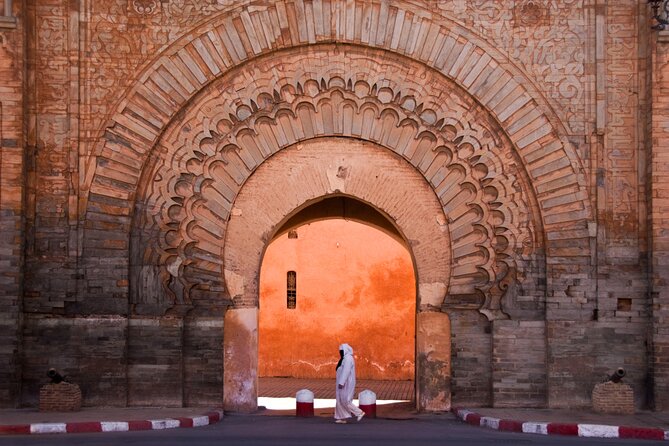
Your tour begins at Bab Agnaou, then moves into the Mellah area, the old Jewish Quarter of Marrakech. This is where you start seeing why the neighborhood mattered. The area’s small lanes were once home to the Jewish community, and you still get a sense of how the streets were built around courtyard life and local institutions.
One of the best parts here is how the guide connects place to daily routine. You are not only learning names of buildings. You also hear why markets mattered, including the significance of the spice market and the gold market, and how those trades connected to Jewish community life.
You will also pass by or get oriented to key nearby landmarks, including the Lazama Synagogue area, plus the Miaara Jewish cemetery nearby. The guide can point out details you might miss if you were walking alone. For example, you will notice the way tiled courtyards and interior spaces are used, and how the neighborhood’s layout supports community gathering.
Then there is the market element. The Mellah area includes a Mellah Market selling meat and fruit, plus the Bab Mellah Spice Souk and herb-focused shops. Even if you are not buying, it is useful to see where spices and everyday ingredients were traded. It gives your guide’s stories a physical anchor.
Practical note: this part of the experience is described as admission-free. That is great, because it lets you focus on the streets and context without worrying about tickets right at the start.
Slat Al Azama Synagogue: architecture, women’s gallery, and what to expect
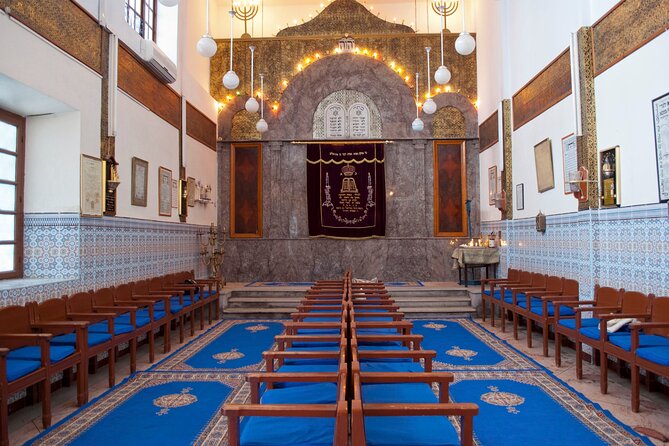
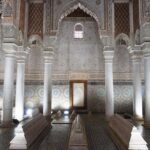
Next comes Slat Al Azama Synagogue (Salat al-azamat). This is a stop you should treat like the tour’s anchor point for understanding the built form of community life. The synagogue is said to have been built around 1492, serving the Jewish community in the Mellah.
The setting is described as traditional: a structure around a central courtyard. That courtyard layout is a big clue for how people gathered and how spaces were organized in a Moroccan context. You also get details about recent changes, including an added women’s gallery (an erzat nachim) on the eastern wall.
The tour also notes that a typically moveable wooden arch was replaced by a marble arch bordering the eastern wall. Even if you are not a design expert, this kind of information helps you understand that religious spaces are living places. They change over time.
Two practical things to know:
- The visit time is listed at about 30 minutes.
- Admission is not included for this stop, so budget for it if you want to go in.
If you are the type who likes to see places clearly and photo-friendly, this is where your guide can help you get oriented quickly. Ask where to stand for the best view of the courtyard and main architectural features.
Miaara Jewish Cemetery: quiet ground, and possible access rules
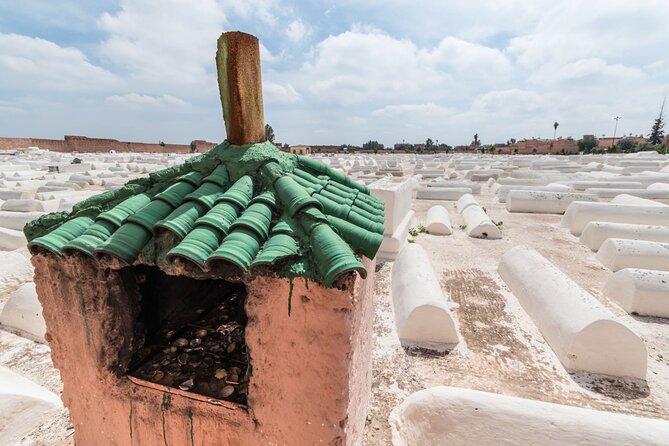
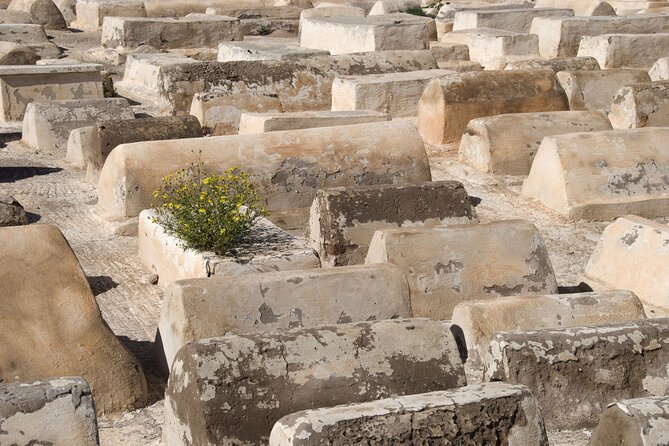
The Mellah also holds the Miaara Jewish Cemetery, described as more than 500 years old. This stop is less about information overload and more about respect and observation. You can see graves with basic appearances and varying sizes, spanning different centuries, plus evidence that some graves are tied to epidemics that ravaged the city, which required hurried burials.
I appreciate cemetery stops when they are handled thoughtfully, with a guide who can explain what you are seeing without turning it into a “quick photo stop.” The tour frames it as a witness to Marrakesh’s long Jewish community presence, not just an old burial ground.
Time on this stop is short, about 25 minutes. That means you should go in with a calm mindset and let the guide’s context guide your attention. Focus on the overall layout and the idea that these graves represent different eras and different circumstances.
Here is the key consideration: admission is not included for the cemetery. Also, there can be situations where cemetery access is restricted depending on local rules tied to a Cohen. That is not something you can control, but it is worth keeping in mind, especially if this cemetery is a top reason you booked.
If the cemetery doors do not open for your exact group, do not panic. Ask your guide what alternative viewing or explanation they can provide on the spot.
Jemaa el-Fnaa and Souk Semmarine: trading stories for shopping reality
After the heritage stops, the tour moves toward Jemaa el-Fnaa, the famous main square. In the plan it is a brief stop, around five minutes, mainly to connect you to the larger city around you. Think of it like a pulse check. You take a moment to register where you are in Marrakech before heading back into the market maze.
Then you get a solid block at Souk Semmarine, around two hours. This is where the tour turns from “learning” to “doing.” You will walk through confusing souks and workshops where you can see handiwork like leather, blacksmith work, and woodwork. Even if you do not buy, it is one of the best ways to understand what kinds of crafts are made locally and what kinds of materials are traded.
If shopping is part of your goal, this is the time to slow down and ask questions. Souks can be chaotic, and the guide can help you judge quality. You also get a more relaxed chance to compare prices and products rather than rushing.
If shopping is not your goal, the craft workshops still matter. They explain the skill base behind the market, and they give you a break from the heavier emotional weight of synagogue and cemetery stops.
Other tours led by the history


Guides make it: Chachi, Noura, Ismail, and Saïd
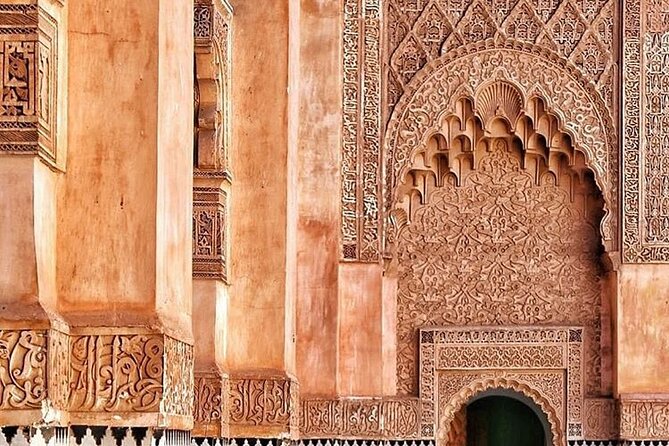
A tour is only as good as the guide handling your questions and pacing. On this one, the names that come up are a strong sign of how personal it can feel. Chachi is highlighted for being phenomenal, with lots of information and extra time in the souk afterward. That kind of extra attention matters because it means you get your guide’s thinking, not just a checklist of stops.
Noura is another name you will hear often. She is described as well informed and very good company, and she even adjusted the experience for mobility needs by reorganizing the route and adding resting time. That is a big deal. Marrakech walking can be harder than it looks, so a guide who can adapt makes the difference between a tour you remember fondly and one you rush through.
Ismail also gets credit for kindness, generosity with time, and clear explanations while walking the alleyways of the Jewish Quarter. That combination, kind plus clear, is exactly what you want when the subject is serious but the streets are crowded.
Then there is Saïd, who is tied to the experience of walking the Jewish Quarter and helping bring the area to life. You can also see from the way different guides are described that the experience is not cookie-cutter. It bends to match the group.
If you care about the route, ask your guide early what they recommend. A simple question like where you should spend extra time can turn your tour into the one that fits your interests.
Price and value: what $95 buys for a half-day
At $95 per person, this tour sits in the “good value if it matches your interests” category. The price includes the guide service and all fees and taxes. For a private experience, that matters. You are paying for guided interpretation of specific places, plus time in the souks with help navigating quality.
The tradeoff is that not every stop’s admission is included. The synagogue and cemetery have separate admission notes, so your real total cost may be a bit higher depending on what you choose to enter. That is normal for tours in Morocco, but it is still something to factor in so there are no surprises.
Also, this is set up as private for your group, and it mentions group discounts. That makes it more appealing if you are traveling with friends or family. Four hours with a guide in Marrakech can get expensive if you are relying on informal guides or piecemeal services, so bundled guidance is the main value driver here.
Another small plus: a mobile ticket is included. That saves time when you arrive and want to get going fast.
Timing, weather, and how to plan the rest of your day
This is a half-day experience, around four hours, and it is designed so the rest of your day belongs to you. That is great in Marrakech, where the afternoons can work in your favor if you plan right. After the tour, you can eat nearby, go back for specific shopping items you saw during Souk Semmarine, or take a slower walk to recover your feet.
The tour also notes it requires good weather. In practical terms, that means if it is rainy, muddy, or extremely uncomfortable, the day might change. Marrakech walking days depend a lot on the conditions, so it helps to keep your schedule flexible.
If you have mobility issues, bring that up at booking. One guide example shows the route can be reorganized and rest time can be included. That sort of adaptation is exactly what you want in a city where the sidewalks can be uneven and the lanes can be crowded.
Who should book this Marrakech Jewish heritage and souks tour?
Book this tour if you want:
- A focused walk through the Mellah with explanation of Jewish community life in Marrakech
- A mix of solemn places and real city markets
- Help navigating the souks, especially if you plan to shop in the craft workshops
- A private, adjustable experience rather than a rigid group script
Skip it, or at least weigh it carefully, if you:
- Expect admissions to be fully included for every single stop
- Only want the quickest possible look at Jewish sites, because some stops depend on access rules and not every section may be available
- Prefer purely leisurely pacing, since you are walking through multiple neighborhoods and market areas in one session
The best fit is travelers who like walking, asking questions, and connecting stories to street-level details.
Should you book this tour?
Yes, if Jewish heritage in Morocco and Marrakech’s souk culture both matter to you. The tour earns its value by pairing named places in the Mellah with time in Souk Semmarine, so you do not leave with only information, you leave with direction for what to do next in the markets.
My booking advice is simple:
- If the synagogue and cemetery are must-sees, ask what admission applies on your day.
- If you have mobility needs, tell them ahead of time so the route can be adjusted.
- Wear shoes you trust and bring water. Four hours in these streets adds up.
If you want a half-day that connects meaningful places to the city you will keep exploring after, this one is a strong choice.
FAQ
How long is the Marrakech Jewish Heritage and souks Tour?
The tour runs for around 4 hours.
What is the price per person?
The price is $95.00 per person.
Is this tour private or group-based?
This is a private experience. Only your group will participate.
What are the main stops on the tour?
You visit the Mellah, Slat Al Azama Synagogue, Miaara Jewish Cemetery, a short stop in Jemaa el-Fnaa, and Souk Semmarine.
What is included in the price?
The guide service and all fees and taxes are included.
What is not included?
Lunch and souvenirs are not included. Admission for Slat Al Azama Synagogue and Miaara Jewish Cemetery is not included.
Where does the tour start and end?
It starts at Bab Agnaou, Marrakech, and ends at Jemaa el-Fna.
Does the tour require good weather?
Yes. The experience requires good weather, and if it is canceled due to poor weather, you will be offered a different date or a full refund.
Tours Led by the History
- Marrakech Historical and Cultural Tour – Half Day City Tour★ 4.5 · 1,180 reviews
- Historical Marrakech Walking Tour★ 5.0 · 198 reviews
- Half Day Guided Tour in Marrakech History & Culture★ 5.0 · 93 reviews
- Private Cultural Tour in Marrakech City★ 5.0 · 77 reviews
Medinas, Souks and Kasbahs Elsewhere
- Shopping in the Souks of Marrakech Private Tour★ 5.0 · 620 reviews
- Souks Shopping Tours★ 5.0 · 395 reviews
- Private Tour: Marrakech Medina By Night★ 5.0 · 389 reviews
- Marrakech: Medina Souks Guided Walking Tour★ 4.5 · 381 reviews
Added recently from around Marrakech

More Medina, Souk and Kasbah Walking Tours worth a look.
 ★ 4.7Marrakech: Bahia Palace, Saadian Tombs, Souk and Medina TourFrom $204,974 reviews
 ★ 4.6Marrakech: Ben Youssef, Secret Garden, & Souks Walking TourFrom $202,802 reviews
 ★ 4.7Marrakech: Colorful Medina Souks Guided Walking TourFrom $202,470 reviews
 ★ 4.6Fez Medina Guided TourFrom $92,079 reviews
 ★ 4.6Marrakech: Saadian Tombs & Bahia Palace, Medina Guided TourFrom $181,989 reviews
 ★ 4.6Fes: Museum, Al Attarine Madrasa & Tannery and Medina TourFrom $131,655 reviews
 ★ 3.8Marrakech Monuments & Souks 3-Hour TourFrom $231,540 reviews
 ★ 4.7Marrakech: Bahia Palace, Madrasa Ben Youssef and Medina TourFrom $191,347 reviews
Where else this one sits