
REVIEW · MARRAKECH
Fes: Bou Inania Madrasa, Museum, Tannery, Souk & Medina Tour
Bab Boujloud can feel like a maze until someone guides your feet. This half-day walk through Fes puts you at the Blue Gate, then strings together top sights like Bou Inania Madrasa, Dar Batha, and the Chouara tannery with time to breathe and look around. I especially like how guides such as Mouanis and Houssine can translate the maze into a story you can follow.
One small drawback to plan for: a chunk of the route is in the Medina on foot, so comfortable shoes and patience with narrow lanes matter.
You’ll also like the craft-focused stops, because you’re not just sightseeing, you’re watching traditions at work, including the tannery dyes and the tile and pottery skills. The souk walk is built around the real names, like Souk Sabaghine for textiles and Souk El Attarine for spices and perfumes, so shopping feels more intentional. The only consideration is budgeting, since key monument tickets are not included and add up once you reach Bou Inania Madrasa and Dar Batha.
In This Review
- Key highlights you will feel fast
- Starting at Bab Boujloud, then letting the Medina make sense
- Dar Batha Museum: a palace that teaches you how Moroccans decorate
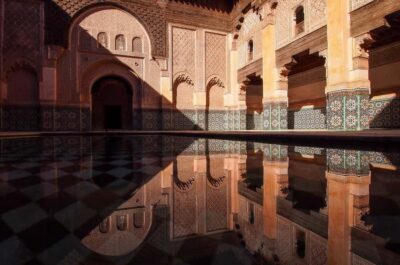
- Bou Inania Madrasa: cedar, zellige, and a courtyard that slows you down
- Al-Karaouine University outside, still powerful inside your head
- Chouara Tannery from the terrace: natural dyes and centuries-old workflow
- Souk time in Fes El Bali: Sabaghine textiles, Attarine scents, and Seffarine metalwork
- Pottery and zellige workshop: where pattern becomes real
- How the 4-hour pace really works (and why free time helps)
- Price and value: what $12 covers, and what you should budget for tickets
- Best-fit traveler: who will enjoy this most
- Should you book this Fes Medina tour?
- FAQ
- How long is the Fes Bou Inania Madrasa, Museum, Tannery, Souk & Medina Tour?
- What is the meeting point for the tour?
- Is hotel pickup included?
- What sights are included in the tour?
- Are entrance tickets included?
- How much does the tour cost?
- What languages are available with the guide?
- Is it a private tour or a group tour?
- Is the tour suitable for people with mobility impairments?
- What should I bring with me?
Key highlights you will feel fast
- Bab Boujloud to Fes El Bali with a local guide so you get oriented fast in UNESCO-listed lanes
- Bou Inania Madrasa featuring carved cedarwood, zellige tilework, and a calm marble courtyard
- Dar Batha Museum inside a former palace with Moroccan arts and crafts
- Chouara Tannery from a terrace to see hand-dye leather in natural pits, using dyes like saffron and indigo
- Souk Sabaghine and Souk El Attarine plus the sound of coppersmiths at Hammam Seffarine
- Pottery and zellige workshop where artisans mold clay, paint ceramics, and cut tiles for mosaics
Starting at Bab Boujloud, then letting the Medina make sense
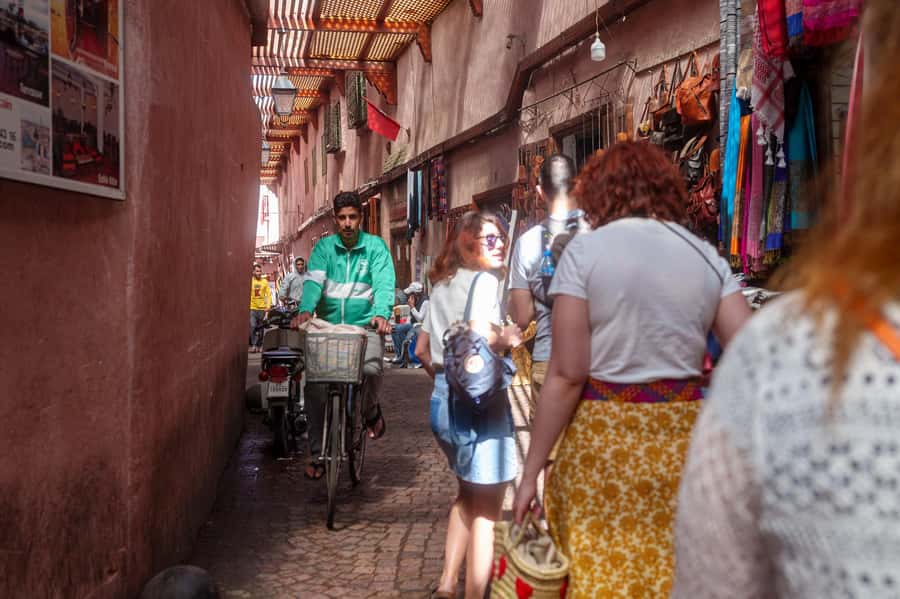
The tour begins near Hotel Batha, at Ave de La Liberte, with a guide who knows how to move through the Medina without turning it into a frantic sprint. From the start, you feel the scale of Fes El Bali. The lanes tighten, the sounds layer up, and suddenly you understand why a guide matters so much here.
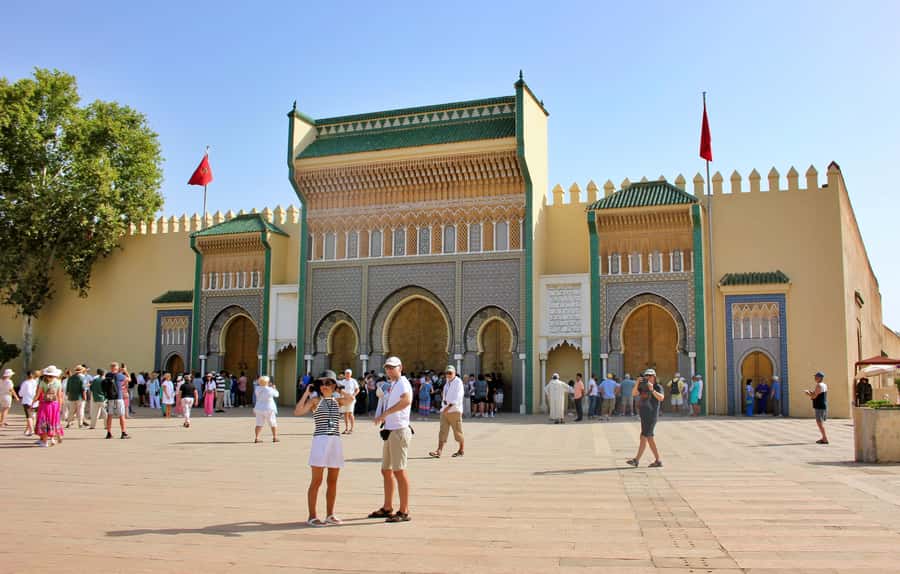
Bab Boujloud, the Blue Gate, is your anchor. It is not just pretty tiles. It is the marker that you are in the old city, with centuries-old streets still shaping daily life. Your guide helps you get your bearings fast, then you get a short context on how Fes grew around scholarship and crafts. That framing is what makes the rest of the stops click, instead of feeling like a checklist.
Walking time is built in for short stretches, then purposeful pauses. You get photo stops and a bit of free time at major points, so you can step back, look up, and notice details like doorways, tile patterns, and workshop signage.
Other medina and souk walks around Marrakesh
- Marrakech: Bahia Palace, Saadian Tombs, Souk and Medina Tour
★ 4.7 · 4,974 reviews - Marrakech: Ben Youssef, Secret Garden, & Souks Walking Tour
★ 4.6 · 2,802 reviews - Marrakech: Colorful Medina Souks Guided Walking Tour
★ 4.7 · 2,470 reviews - Marrakech: Saadian Tombs & Bahia Palace, Medina Guided Tour
★ 4.6 · 1,989 reviews
Dar Batha Museum: a palace that teaches you how Moroccans decorate
Dar Batha is one of those places where the setting already tells half the story. It used to be a palace, and now it houses Moroccan Islamic arts and craft traditions. On this tour, you get a photo stop, then a guided visit, plus some free time to wander at your own pace.
What I like about Dar Batha is that it helps you “read” the art you’ll see later in the Medina. Carved wood, ceramics, and textile work are not random. They connect to how people lived, prayed, celebrated, and traded. You start to see that the same design logic shows up again and again, from the zellige on walls to the way patterns flow across objects.
The guided portion is helpful because it points out what to look for, like how materials are layered and how ornament follows function. Then the free time lets you linger where your eye wants to linger.
One practical note: Dar Batha has an entrance ticket cost (20 MAD per adult) that is not included in the $12 price. Plan to have cash available so you are not scrambling at the door.
Bou Inania Madrasa: cedar, zellige, and a courtyard that slows you down
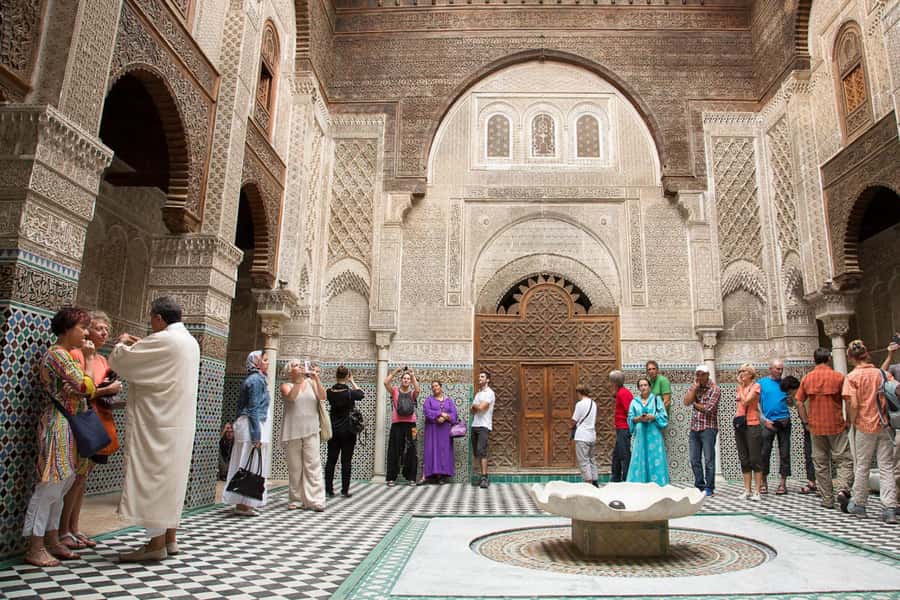
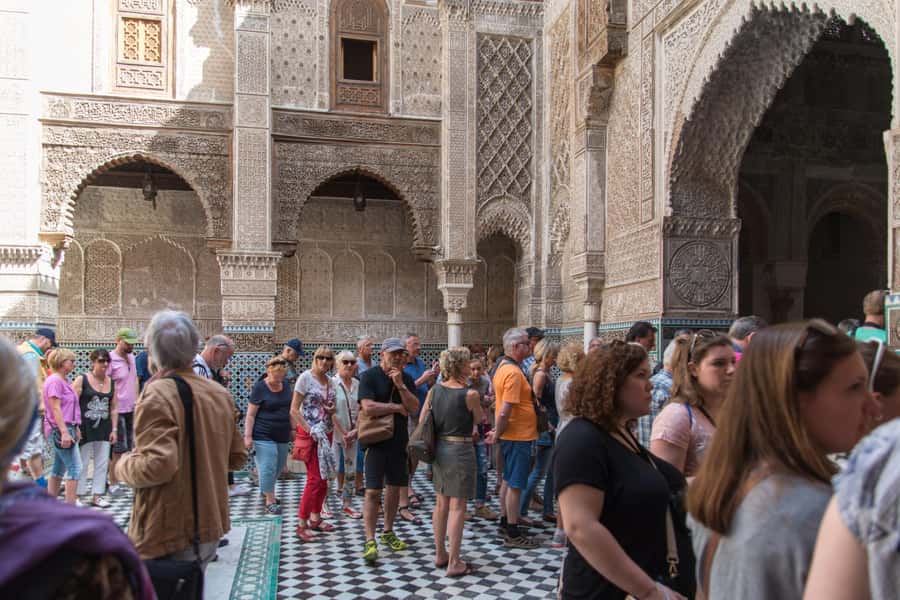
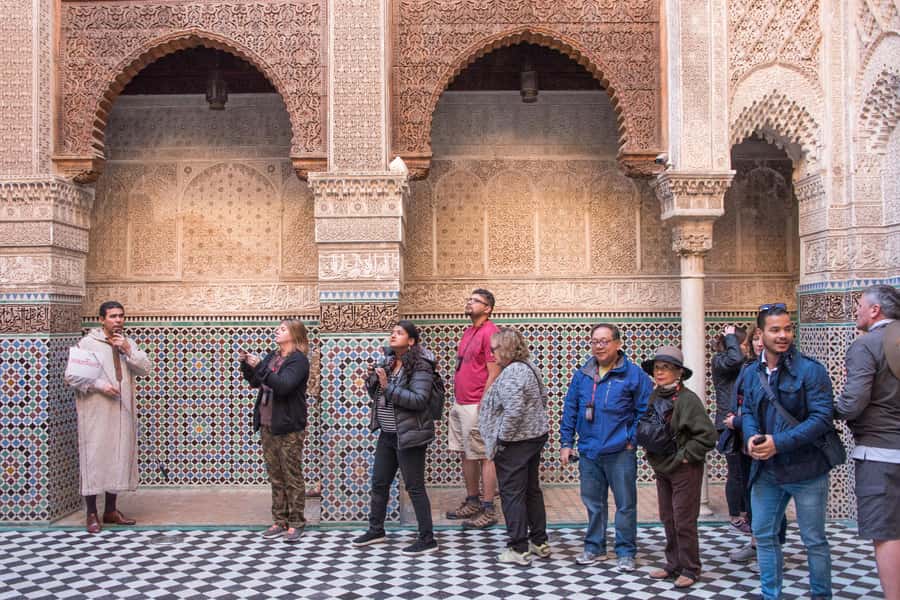
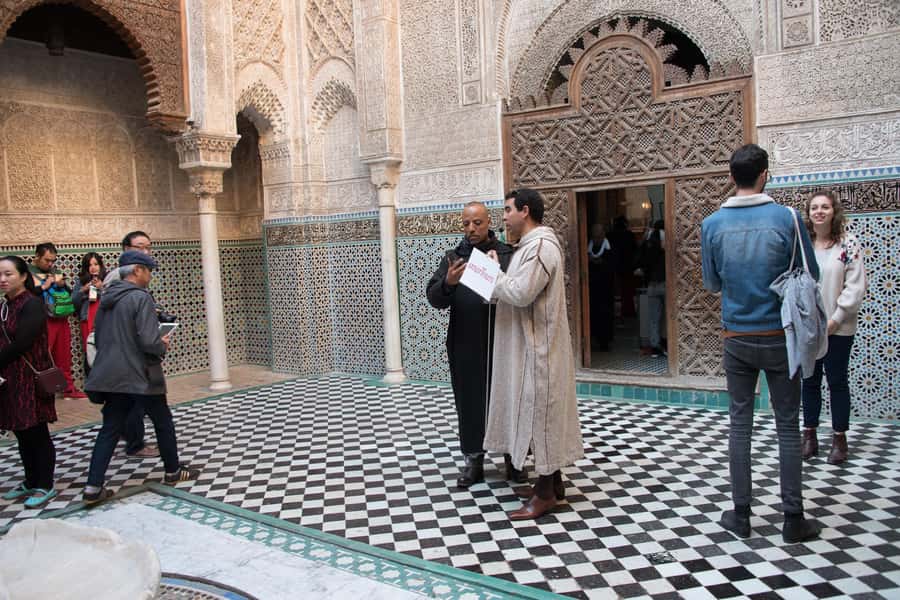
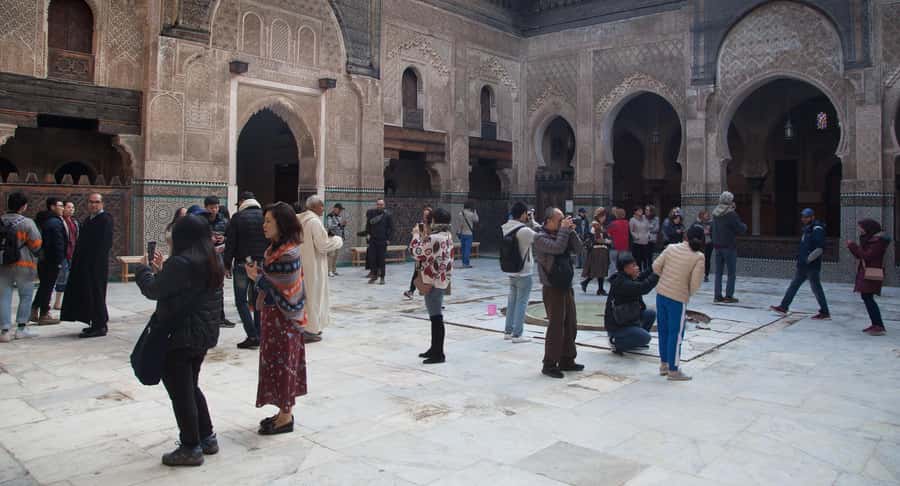
Bou Inania Madrasa is the kind of stop where you feel your brain go quiet for a moment. This 14th-century Marinid masterpiece mixes carved cedarwood, intricate zellige tilework, and a serene marble courtyard that gives you a break from the noise outside.
On the tour, you get a photo stop and guided visit, plus some time to explore. Even if architecture is not your thing, the details are hard to ignore. Cedar carving creates texture you can almost feel with your eyes. Zellige patterns do not just decorate, they guide your gaze and create a sense of order.
Bou Inania is also special because it served both scholarly and religious roles, and it is one of the madrasas that also functioned as a mosque. Your guide’s explanation helps you understand why that matters. It is not just a pretty building. It was part of how knowledge moved through the city.
Entrance tickets for Bou Inania Madrasa are also not included (20 MAD per adult). Also, because you get skip-the-line access to selected monuments, you lose less time and spend more time looking closely. In a place like Fes, that is real value.
Al-Karaouine University outside, still powerful inside your head
Next comes the Mosque and University of Al-Karaouine, visited from the outside on this tour. Even without entering, this is one of the stops that makes Fes feel like a living center of learning rather than a museum city.
Al-Karaouine is described as one of the world’s oldest universities, and the exterior view still lands. Your guide connects the site to Fes as an intellectual and spiritual center, shaped by scholars and students across centuries. You do not need to be a history expert to get it. You just need the “why.”
If you are the kind of traveler who loves a sense of place, you will enjoy how the route links what you saw at Bou Inania to what you’re seeing here. The whole tour has a theme: Fes built itself around study and craft.
Chouara Tannery from the terrace: natural dyes and centuries-old workflow
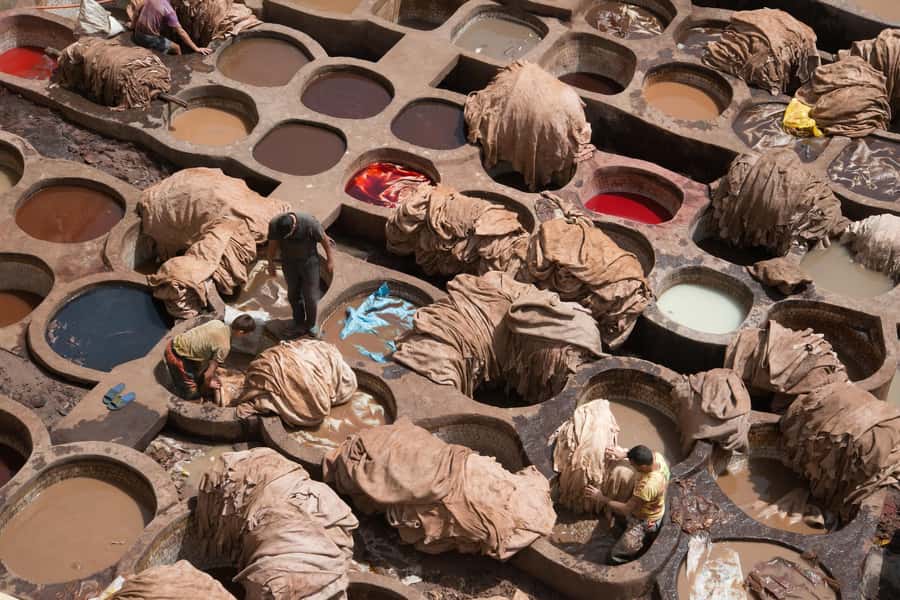
The Chouara Tannery is the tour’s most sensory stop. Leather is not made quietly, and the tannery pits are part of a process that has lasted for generations. Even though you see it from a panoramic terrace, you can still grasp how the workflow works.
What you’re watching is artisans hand-dyeing leather in colorful pits. Natural dyes are used, with examples like saffron and indigo mentioned as part of the tradition. The tour describes this as a practice unchanged since the 11th century. Whether you measure history in centuries or generations, the key idea is the continuity of technique.
Practical tip: plan your expectations. Leather-making means strong smells and busy activity. You do not have to like the smell, but you should understand you are witnessing work, not a staged demo. Your guide helps you notice what you’re seeing and what it means, which makes the terrace view more than just a photo moment.
This is also where shopping temptation shows up. The tannery area is connected to leather goods sales, and it is normal to be approached. If you want to buy, you will get guidance on what you’re looking at and what questions to ask. If you do not want to buy, you still get the educational value of watching the process.
Souk time in Fes El Bali: Sabaghine textiles, Attarine scents, and Seffarine metalwork
After the tannery, you shift back into the Medina’s everyday rhythm: souks. The tour focuses on specific markets instead of wandering randomly, and that makes a big difference in how much you notice.
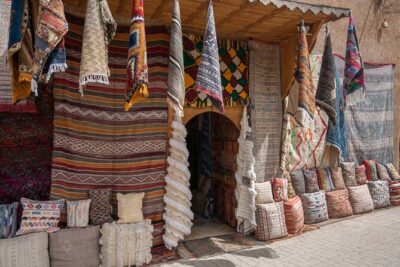
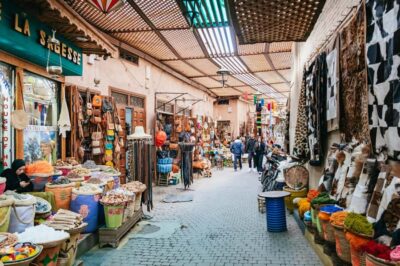
You’ll visit Souk Sabaghine, known for handwoven textiles. This is not just about fabric on display. It is about the idea of work being made close to where it is sold, meaning you can often connect an item to a craft tradition.
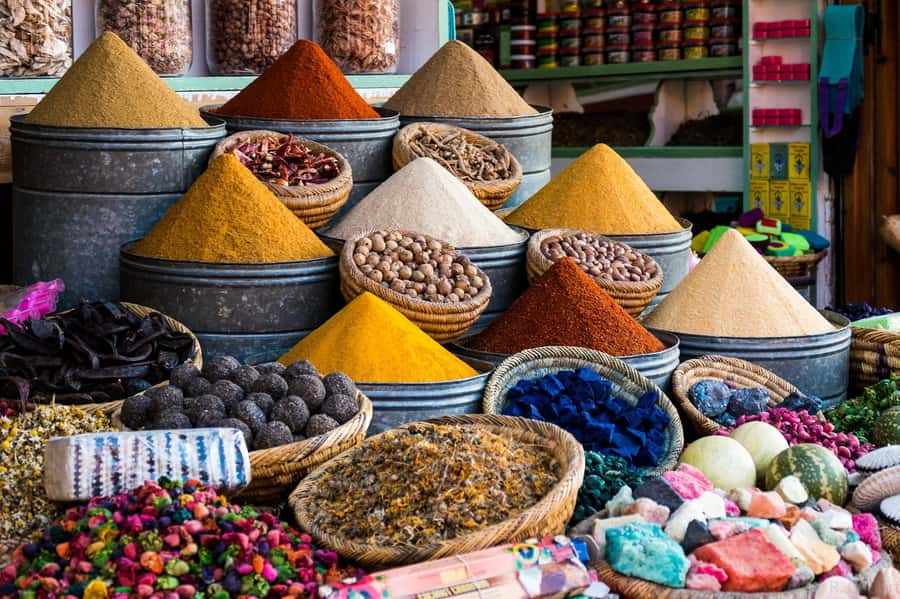
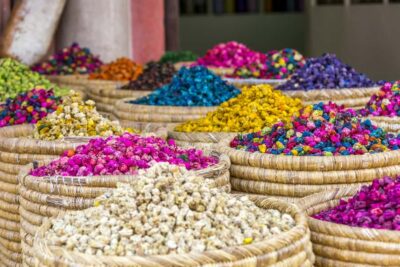
Then comes Souk El Attarine, packed with spices, perfumes, and herbal remedies. Expect strong smells and a lot of visual intensity. Your guide helps you sort what is what, so you can ask questions without feeling lost or pressured.
Nearby, you can hear Hammam Seffarine, where coppersmiths hammer metal. That sound is a form of direction. Even if you cannot yet understand every word in Arabic or French, the rhythm tells you you are in the right section of the craft world.
One thing I appreciate here is the tour’s balance: craft education plus time to roam the souks. Many people only visit one market and leave thinking they saw “the souk.” This route gives you more variety, so you start to understand how each souk specializes.



Pottery and zellige workshop: where pattern becomes real
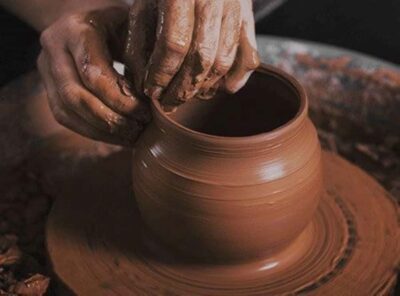
Toward the end, the tour shifts to a more hands-on feeling place: a pottery and zellige tile workshop. You’ll see artisans mold clay, hand-paint ceramics, and cut delicate zellige tiles for mosaic designs.
Why does this matter? Because zellige is everywhere in Fes, but it can look like pure decoration until you see the process. Watching tiles being cut and arranged makes the patterns on buildings feel logical instead of magical. You begin to recognize why some designs look sharper or more complex. It comes down to craft steps and precision.
This workshop also helps if you like souvenirs but want them to mean something. If you buy a ceramic or tile item, you will understand the effort behind it, even if you cannot quote every technical detail.
Shopping does show up here, too, since workshops typically sell what they make. Your best move is to treat it like a craft visit first. Ask questions, compare pieces, and only then decide what is worth bringing home.
How the 4-hour pace really works (and why free time helps)
This tour is designed for about 210 minutes, around 4 hours. That time is not wasted in long bus rides because you are walking. The route moves from Bab Boujloud through major monuments and into the souks, with short stops and guided segments.
The rhythm usually looks like this: a quick orientation, a guided visit that gives context, then free time to explore at your own pace. That free time is important because Medina sightseeing is not linear. Sometimes you spot a doorway, a tile panel, or a craft detail, and you want a minute to look closer.
I also like that you get skip-the-line access to selected monuments. In older cities, waiting can quietly eat your day. Here, the structure is built so you see key places without spending half your time standing in queues.
Group sizes can be small, and there is a private option available. If you want a less chaotic feel, small-group tours tend to work better, especially in tight alleys.
Price and value: what $12 covers, and what you should budget for tickets
The base price is $12 per person, which is excellent for a guided, craft-focused half-day. But you should understand what is included and what is not.
Included:
- A licensed local guide
- Private or small-group walking tour (depending on your option)
- Skip-the-line access to selected monuments
- Free time at each monument to explore
- WhatsApp reminder with guide name, meeting point, and helpful tips
- Hotel pickup from your riad in the Medina for private option only
Not included:
- Entrance tickets to Bou Inania Madrasa (20 MAD per adult)
- Entrance tickets to Dar Batha Museum (20 MAD per adult)
- Transportation and food and drinks
So for many adults, the real add-on cost is those two monument tickets. If you book, I’d treat the $12 as the “guide and walking value,” and then budget separately for monument entry. Do that and you’ll feel like you got a great deal, because you are not just walking, you’re getting interpretation.
Also consider that a guide saves you from time-consuming missteps in the Medina. Even if you are an experienced wanderer, you still risk missing the connections that make Fes make sense. The price is low enough that you can justify the guide as the key ticket.
Best-fit traveler: who will enjoy this most
This tour is a strong choice if you are:
- Short on time but want multiple top sights in Fes El Bali
- Interested in craft traditions, not only architecture
- Shopping with purpose, especially for textiles, leather, and ceramics
- Someone who prefers a guide to help you navigate narrow lanes and find the right entrances
It also tends to work well for families. One family tour was specifically noted as paced for kids, with no rushing. That kind of timing matters because Fes can be exhausting if you try to do everything alone.
If you dislike shopping stops, you still get plenty of sightseeing. But you should know that the route includes workshops and craft-linked areas where purchases are possible. If you are not interested in buying, just focus on the process and say no politely if someone tries to sell.
Should you book this Fes Medina tour?
Book it if you want the Medina’s highlights with a guide who can connect buildings, markets, and crafts into a story you can actually follow. I think it is especially worth it for first-timers to Fes, or for anyone who wants to see Bou Inania Madrasa, Dar Batha, and the Chouara tannery without spending days figuring it out.
Skip or reconsider if you hate walking through narrow lanes and strong smells, or if you want a totally unstructured wandering day with zero workshop or shop stops. This is a guided route with craft-focused pacing, and it rewards people who like a plan.
If you do book, bring the practical stuff: comfortable shoes, water, cash, plus sunscreen and sunglasses. And when you meet your guide, ask one simple question early, like what should you look for first at each stop. That one question keeps your whole 4 hours feeling meaningful.
FAQ
How long is the Fes Bou Inania Madrasa, Museum, Tannery, Souk & Medina Tour?
The tour lasts 210 minutes, about 4 hours.
What is the meeting point for the tour?
Your guide waits in front of Hotel Batha on Ave de La Liberte in Fes.
Is hotel pickup included?
Pickup is optional. If your accommodation is inside the Medina, your guide picks you up from your accommodation reception on the private option. If you are outside the Medina, you meet at Hotel Batha.
What sights are included in the tour?
You will visit Bab Boujloud, Dar Batha, Bou Inania Madrasa, Al-Karaouine University and mosque exterior, the Chouara tannery, the Medina of Fes souks, and you also stop at a pottery and zellige tile workshop. The route includes Souk Sabaghine and Souk El Attarine, plus Hammam Seffarine.
Are entrance tickets included?
No. Entrance tickets are not included for Bou Inania Madrasa (20 MAD per adult) and Dar Batha Museum of Islamic Arts (20 MAD per adult).
How much does the tour cost?
The price is listed as $12 per person.
What languages are available with the guide?
The tour offers live guiding in French and English.
Is it a private tour or a group tour?
It can be private or a small group, depending on the option you select. A private group is also available.
Is the tour suitable for people with mobility impairments?
The activity is marked as not suitable for people with mobility impairments, even though wheelchair accessibility is listed. Because this is a walking tour in the Medina, you should think carefully about your comfort level with the route and narrow lanes.
What should I bring with me?
Bring comfortable shoes, sunglasses, sunscreen, water, and cash.
Museums and Timed Tickets
- Marrakech: Majorelle Garden, YSL, and Berber Museum Entry★ 4.6 · 5,168 reviews
- Marrakech: Palace, Museum, Madrasa & Medina Highlights Tour★ 4.7 · 706 reviews
- Marrakech: Majorelle Garden, Museums Tickets, & Audio Guide★ 4.6 · 38 reviews
Medinas, Souks and Kasbahs Elsewhere
- Marrakech: Bahia Palace, Saadian Tombs, Souk and Medina Tour★ 4.7 · 4,974 reviews
- Marrakech: Ben Youssef, Secret Garden, & Souks Walking Tour★ 4.6 · 2,802 reviews
- Marrakech: Colorful Medina Souks Guided Walking Tour★ 4.7 · 2,470 reviews
- Marrakech: Saadian Tombs & Bahia Palace, Medina Guided Tour★ 4.6 · 1,989 reviews
Added recently from around Marrakesh


More Medina, Souk and Kasbah Walking Tours worth a look.
 ★ 4.7Marrakech: Bahia Palace, Saadian Tombs, Souk and Medina TourFrom $204,974 reviews
 ★ 4.6Marrakech: Ben Youssef, Secret Garden, & Souks Walking TourFrom $202,802 reviews
 ★ 4.7Marrakech: Colorful Medina Souks Guided Walking TourFrom $202,470 reviews
 ★ 4.6Fez Medina Guided TourFrom $92,079 reviews
 ★ 4.6Marrakech: Saadian Tombs & Bahia Palace, Medina Guided TourFrom $181,989 reviews
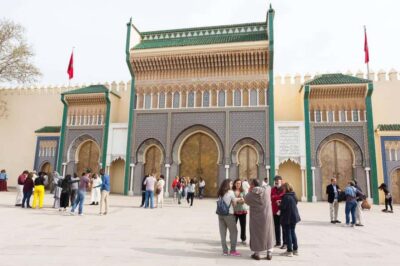 ★ 4.6Fes: Museum, Al Attarine Madrasa & Tannery and Medina TourFrom $131,655 reviews
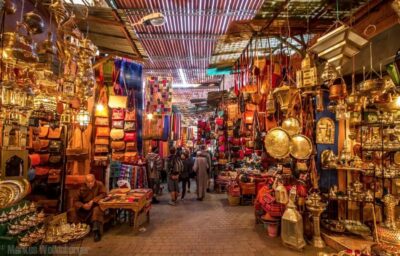 ★ 3.8Marrakech Monuments & Souks 3-Hour TourFrom $231,540 reviews
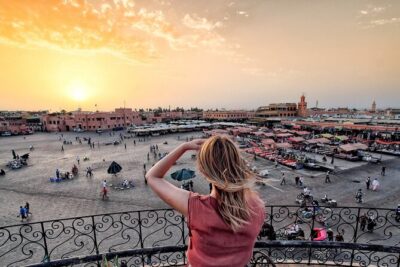 ★ 4.7Marrakech: Bahia Palace, Madrasa Ben Youssef and Medina TourFrom $191,347 reviews
Where else this one sits