
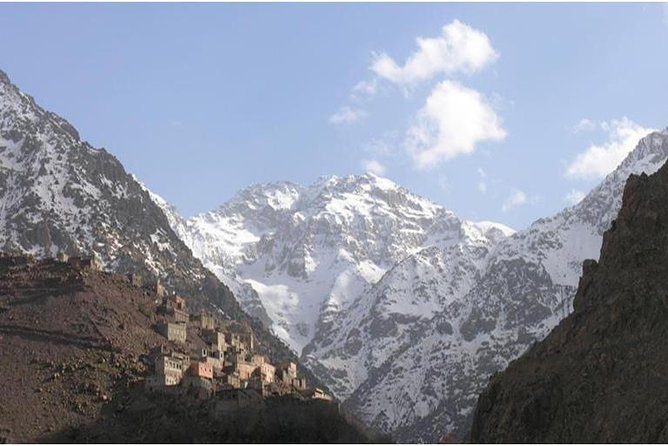
REVIEW · ATLAS MOUNTAINS
Mount Toubkal: 2-Day Climb from Marrakech
Two days on Toubkal feels like a lifetime. You’re chasing the 4167m peak of North Africa, and you’re doing it with meals handled and a night at the Toubkal Refuge waiting for you.
This is a serious hike, not a Sunday stroll. The summit day includes a long push at altitude, so you need steady pacing and a calm head when the air gets thin.
If you’re the type who likes clear instructions and smooth communication, do yourself a favor and ask a few questions up front. Even when the guiding is strong, some parts of the experience can feel under-communicated, especially around pickup timing and gear details.
In This Review
- Quick take: what makes this Toubkal climb worth it
- Getting from Marrakech to Imlil: where the trip really starts
- Day 1 trek: Aremd, Sidi Chamharouch waterfall stop, and the climb to the refuge
- What to watch for on day 1
- Day 2 summit to 4167m: the early start, the views, and the long descent
- Altitude reality check (the part that decides your day)
- Toubkal Refuge overnight: what you’re paying for (and how to sleep smarter)
- How to protect your sleep
- Guides, mules, and the gear checklist you should not skip
- The gear and support piece: confirm before you commit
- Communication and pickup: keep your safety net ready
- Price and logistics: is $150 good value for 2 days on Toubkal?
- Who should book this 2-day climb, and who should consider a longer trek
- Should you book this Toubkal 2-day climb?
- FAQ
- How much does the Mount Toubkal 2-day climb cost?
- What’s included in the tour price?
- Are drinks included?
- What time does the tour start, and where do you meet?
- What is the daily walking schedule?
- What are the group limits?
- Do you summit the highest peak in North Africa?
- What is the cancellation policy?
Quick take: what makes this Toubkal climb worth it
- Summit of North Africa (4167m) with huge views stretching across the Atlas and beyond
- Overnight at Toubkal Refuge with breakfast, lunch, and dinner included
- Areal walking day structure (first day to the refuge, second day to the top and back down)
- Private transport from your hotel or riad in Marrakech plus a scheduled start time
- Small group size on paper (max 6), which usually helps with pace and safety
- Gear reality check: cold summit mornings are common, and you should confirm sleeping bag and mule arrangements
Getting from Marrakech to Imlil: where the trip really starts
Most days begin with a pickup from your hotel or riad in Marrakech, then a drive south toward the Atlas foothills. The program’s meeting time is listed as 8:30am, and the day’s rhythm usually follows that morning start, with travel and a short welcoming moment before you’re in trekking mode.
Imlil is your gateway. This is where you trade city noise for mountain air, meet your guide, and get your first real sense of the altitude and weather. The altitude change is part of the experience, but it’s also why this climb can feel harder than people expect.
You’ll also pass through key valleys and villages, including Aremd, described as the biggest and highest village in the Imlil Valley. Even if you’ve never cared about “local scenery,” this drive teaches you where you are in the Atlas system, because the routes you’ll walk the next day feel connected to what you see from the road.
Other ways up into the Atlas
- Berber villages : Atlas Mountains Day Hike from Marrakech
★ 5.0 · 14,007 reviews - Atlas Mountains & 5 Valleys Tour from Marrakech – All inclusive –
★ 5.0 · 2,913 reviews - Atlas Mountains, Berber Villages and Three Valleys all inclusive
★ 5.0 · 2,471 reviews - Atlas Mountains Hot Air Balloon Ride from Marrakech with Berber Breakfast and Desert Camel Experience
★ 5.0 · 2,123 reviews
Day 1 trek: Aremd, Sidi Chamharouch waterfall stop, and the climb to the refuge
On day 1, the walking portion is typically 4 to 5 hours. That’s long enough to get your legs working, but it’s also the warm-up for the harder day waiting in the dark.
You begin leaving Imlil behind and head through Aremd, then onward toward the shrine of Sidi Chamharouch. This stop matters because it breaks the climb into human moments. You’re not just moving uphill, you’re learning where faith, community, and mountain life intersect.
Lunch is built into the day. There’s a planned 1-hour lunch break, and it includes time near a cascading waterfall by the shrine area. It’s a nice reset point, and it also helps you understand how the day’s pacing works, because the terrain keeps changing, and you don’t want to burn energy too early.
After that, the trek begins its steady gain. The route snakes and zigzags upward toward the Toubkal Refuge where you’ll stop for the night. The “feel” of day 1 is a gradual climb that teaches you patience. If you go out too fast, you’ll feel it later when the summit starts.
What to watch for on day 1
The biggest mistake is treating day 1 like the hardest part. In reality, day 2 is the test. Use day 1 to lock in your rhythm: slow steps, consistent breathing, and quick micro-rests.
Day 2 summit to 4167m: the early start, the views, and the long descent
Day 2 starts early. The aim is to reach the summit of Mount Toubkal (4167m) when conditions are best, and that usually means waking up while it’s still dark. You’ll then hike up to the top, descend to the refuge for lunch, and continue back down toward Imlil for the drive back to Marrakech.
The total walking time is listed at around 8 hours for day 2. That includes the summit push and the descent. This is why the climb feels like two hikes in one day: uphill effort when you’re cold and focused, then long downward legs that still demand control.
At the summit, the program highlights an incomparable view of the Atlas Mountains and the Sahara Desert environments. Even if you’ve seen mountain views before, the scale here hits different because you’re high enough to notice how the landscape funnels toward the desert.
The descent is not a victory lap. After the summit, your body is tired, and altitude can still affect you as you move downward. Keep your pace conservative, especially if you feel lightheaded, nauseous, or unusually fatigued.
Altitude reality check (the part that decides your day)
One theme shows up again and again: people underestimate how altitude feels once you’re near the top. You can be fit and still get hit. Your best strategy is simple: move slower than you think you should, and take breaks before you feel desperate.
If you’re prone to altitude issues, I’d strongly consider a longer trek with acclimatization. The 2-day format gives you less time to adjust, which can turn a tough day into a rough one.
Toubkal Refuge overnight: what you’re paying for (and how to sleep smarter)
Your overnight stay is at Toubkal Refuge, included in the package, along with meals: breakfast, lunch, and dinner. The point of the refuge night is not comfort like a hotel, it’s timing. It puts you close to the summit start so you can go early and return the same day.
In practice, the refuge is a busy stop for hikers. Rooms can be shared, and sleep quality may vary based on how full it is and how cold it gets. Some people report blankets being the main bedding, even when a sleeping bag is listed as part of the included gear.
How to protect your sleep
Bring what keeps you warm. Summit mornings can be brutally cold, and cold ruins everything, including your mood and your energy for the descent. If you already own a sleeping bag, bring it. If you’re relying on what’s included, plan to double-check what will be provided.
Also pack a small set of warm layers for the refuge night. You’ll be glad you did when you wake up and realize your body is still cooling down while everyone else is trying to stand up and function.
Guides, mules, and the gear checklist you should not skip
The guides are one of the best parts of the experience when everything clicks. In the better moments, guides are energetic, encouraging, and focused on safety, and they also help you make sense of the Berber culture and the mountain life around you.
Names that have come up include Hussein, Saeed, Kamal, Mohammed, Mustafa, Abdo, Said, and Mohamed Ali. The point isn’t the celebrity factor. The point is that guide personality can change how the trek feels day to day, especially on the summit push.
The gear and support piece: confirm before you commit
The program says mule support to carry bags and a sleeping bag are included. But real-world experience can be messy, and some hikers have reported carrying their own bags and using blankets instead of a sleeping bag.
So treat those items as “included in theory,” not “guaranteed exactly as you imagine.” I’d confirm ahead of time:
- Will a mule carry your bag, or will you carry it?
- Is a sleeping bag truly included, or should you bring your own?
- What time is pickup for your exact Riad or hotel location?
Also plan for a cold summit day. Bring layers, wind protection, and warm gloves. One strongly practical item is a head torch for the summit start, since you’ll likely be hiking in very dark conditions.
Walking poles can help on steep terrain. Good hiking boots matter, especially when the ground is rough and traction matters.
Communication and pickup: keep your safety net ready
Pickup issues tend to happen when expectations are vague. If your meeting point is not clear, pick a landmark that your driver can find quickly. I’ve seen advice to use easy-to-spot locations like Café de France in the main square area, because it reduces the risk of standing around wondering.
If you don’t get clear pickup instructions in advance, send a quick message or confirm the pickup point. If you hate uncertainty, you’ll enjoy the climb more once this piece is handled.
Price and logistics: is $150 good value for 2 days on Toubkal?
At $150 per person, you’re paying for more than walking. You’re paying for private transport from your hotel or riad, a guide, the refuge overnight, mule support (listed), meals (breakfast, lunch, dinner), plus a sleeping bag (listed).
That value adds up because two-day treks often get expensive once you price each piece separately: transport to Imlil, a competent guide for altitude terrain, and a bed at the refuge with meals after a full day on foot.
Still, value depends on whether included gear and support match what you actually receive. If you end up carrying your own bag and relying on blankets instead of a true sleeping bag, you’re taking on more responsibility and packing weight. It may still be worth it, but it changes the “easy mode” feeling.
If you’re ready to hike hard, plan for cold, and confirm the mule and sleeping bag details, then the price is fair. If you want a fully hands-off experience with zero gear surprises, you’ll want to verify those specifics before you go.
Who should book this 2-day climb, and who should consider a longer trek
This trek is for people with base-level fitness who can handle rough terrain and a long summit day. It’s also for hikers who don’t need their day to be comfortable.
If you’ve done hikes before, or you can commit to slower pacing, you’ll likely feel more in control. If you know altitude hits you hard, or you want more time to acclimatize, a longer trek with extra days can make a big difference.
This also suits people who like authentic mountain moments: village life, shrine stops like Sidi Chamharouch, and a refuge night that puts you among hikers from different places. You’re not just buying a summit, you’re buying a full mountain day in the Atlas.
Should you book this Toubkal 2-day climb?
Book it if you want a straightforward, two-day route to the highest peak in North Africa, and you’re comfortable with early mornings, cold air, and a tough day 2. The combination of private transport, an included refuge night, and meals makes it a good deal once you’re mentally prepared for the effort.
Skip it or upgrade to a longer acclimatization option if you get altitude symptoms easily, want more buffer time, or you’re the kind of traveler who needs crystal-clear communication and zero ambiguity. Either way, confirm sleeping bag and mule details, pack layers and a head torch, and plan your pickup so you start the hike with confidence instead of stress.
FAQ
How much does the Mount Toubkal 2-day climb cost?
The price is $150.00 per person.
What’s included in the tour price?
Private transport from and back to your hotel or riad in Marrakech, a guide, overnight accommodation in Toubkal Refuge, all food for two days (breakfast, lunch, dinner), mule to carry the bags, and a sleeping bag.
Are drinks included?
No. Drinks are not included.
What time does the tour start, and where do you meet?
It starts in Marrakech at 8:30am, with pickup offered from your hotel or riad in Marrakech.
What is the daily walking schedule?
Day 1 includes about 4 to 5 hours of walking. Day 2 is around 8 hours of walking.
What are the group limits?
A minimum of 2 people is required per booking, and the tour has a maximum of 6 travelers.
Do you summit the highest peak in North Africa?
Yes. The climb is to the summit of Mount Toubkal, the highest peak in North Africa at 4167m.
What is the cancellation policy?
You can cancel for a full refund up to 24 hours in advance of the experience’s start time. If you cancel less than 24 hours before, the amount paid is not refunded.
Higher Into the Atlas
- Berber villages : Atlas Mountains Day Hike from Marrakech★ 5.0 · 14,007 reviews
- Atlas Mountains & 5 Valleys Tour from Marrakech – All inclusive –★ 5.0 · 2,913 reviews
- Atlas Mountains, Berber Villages and Three Valleys all inclusive★ 5.0 · 2,471 reviews
- Atlas Mountains Hot Air Balloon Ride from Marrakech with Berber Breakfast and Desert Camel Experience★ 5.0 · 2,123 reviews
Added recently from around Marrakech
More Atlas Mountains and Berber Village Trips worth a look.
 ★ 4.8Marrakech: Atlas Mountains, Ourika Valley, Waterfall & LunchFrom $1615,834 reviews
 ★ 5.0Berber villages : Atlas Mountains Day Hike from MarrakechFrom $1514,007 reviews
 ★ 4.9Marrakesh: Ourika Waterfalls, Atlas Mountains, Guide + LunchFrom $179,986 reviews
 ★ 4.8From Marrakech: Atlas Mountains Full-Day Hiking Trip w LunchFrom $267,417 reviews
 ★ 4.8Marrakech: Atlas Mountains & Agafay Desert Tour w Camel RideFrom $145,080 reviews
 ★ 4.8From Marrakech: Atlas Mountains Day Trip with Camel RideFrom $174,709 reviews
 ★ 4.9Marrakech: Atlas Mountains, Waterfalls, Ourika Valley +LunchFrom $113,544 reviews
 ★ 5.0Atlas Mountains & 5 Valleys Tour from Marrakech – All inclusive –From $912,913 reviews
Where else this one sits